

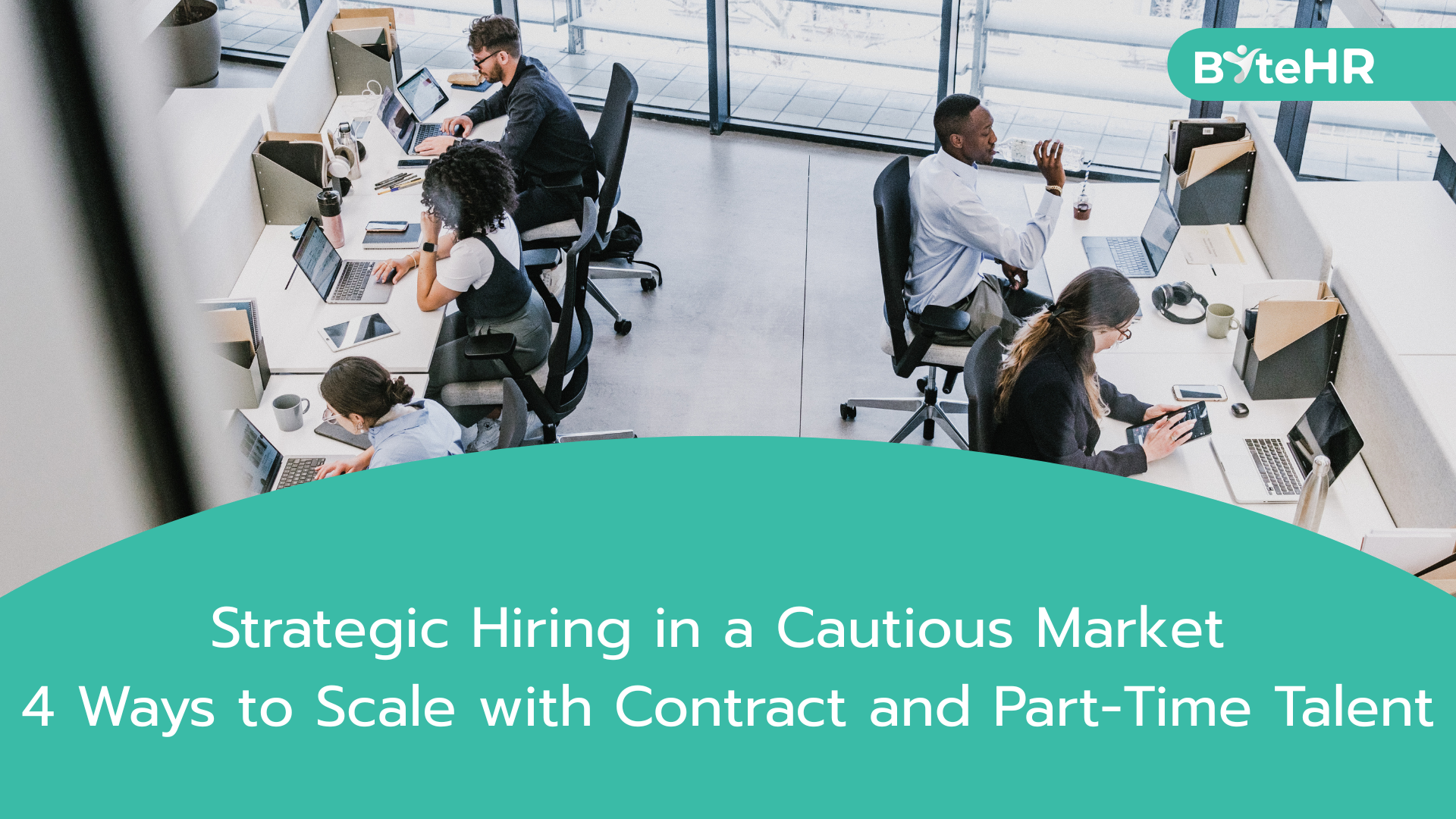
Strategic Hiring in a Cautious Market | 4 Ways to Scale with Contract and Part-Time Talent

The economic climate in Malaysia has become increasingly nuanced. Business owners and HR managers are no longer operating in an environment of unlimited growth. Instead, we are seeing a period of calculated caution where permanent headcount expansion is being approached with significant hesitation. Many companies are holding back on full-time recruitment to keep overheads manageable while navigating market fluctuations. Yet, the work still needs to get done. Customer demand persists, production targets remain, and operational goals do not simply vanish during uncertain times.
This tension between the need for productivity and the desire for financial stability has triggered a major shift in the Malaysian workforce. We are witnessing a surge in project-based, contract, and part-time hiring. This transition allows businesses to scale their workforce up or down based on actual demand rather than future projections. While this strategy is highly effective for maintaining a healthy bottom line, it introduces a new layer of administrative complexity. Managing a hybrid workforce of permanent, contract, and part-time staff requires a robust system to ensure that payroll, compliance, and scheduling do not become a source of operational friction.
The Rise of the Flexible Workforce Model
The Malaysian labor market is currently prioritizing agility. For SMEs and large manufacturers alike, relying solely on a permanent workforce can be a liability when markets take an unexpected turn. By integrating a significant percentage of contract and part-time talent, businesses can pivot rapidly. If a specific production line requires extra support for a three-month surge, a contract workforce provides the necessary labor without the long-term commitments of permanent employment.
However, the challenge lies in the execution. If your HR processes are manual or reliant on legacy spreadsheets, adding a layer of contract workers will inevitably lead to errors. Calculating disparate pay cycles, managing shift rotations for temporary staff, and ensuring that all workers comply with the Employment Act requires a high degree of precision. The companies that succeed in this environment are those that stop treating contract staff as an administrative "exception" and instead build them into the core of their digital infrastructure.

Why Manual Administration Becomes a Liability
When you add part-time and contract staff to your payroll, your administrative workload does not just increase linearly; it compounds. Permanent employees typically follow a fixed schedule and a monthly salary cycle. Contract workers, however, often operate on daily rates, weekly pay cycles, or variable hourly rates linked to specific outputs.
Tracking these variables manually is a recipe for disaster. Human error in payroll processing can lead to demotivated staff, compliance breaches, and significant internal churn. In a market where your workforce is your most valuable asset, any delay in payroll or confusion regarding shift schedules can drive your best talent to competitors. To scale successfully, you must move away from reactive administrative work and toward proactive workforce management.
Essential Strategies for Managing Your Hybrid Workforce
Successfully integrating contract and part-time talent into your daily operations requires a focus on four key pillars.
1. Digitise Your Scheduling and Shift Planning
One of the biggest hurdles in managing a hybrid workforce is keeping track of who is working when. Contract and part-time employees often have varying availability. If your scheduling is done via whiteboard or fragmented messaging apps, you are bound to face coverage gaps. A digital shift scheduling tool is essential here. It allows you to view your entire roster in one place, ensuring that you always have the right mix of permanent experts and temporary support on the floor at any given time.
2. Automate Payroll for Multiple Pay Cycles
Managing different payroll structures can be overwhelming. Some workers may need weekly payments, while others might be paid based on output. Automation is the only way to manage this without increasing your HR headcount. By using an HR system that supports automated payroll calculation, you eliminate the risk of manual miscalculation. You set the rules once, and the system applies them consistently across every contract worker, regardless of their pay cycle.
3. Standardise Onboarding and Compliance
A common mistake in Malaysian businesses is having a simplified onboarding process for part-time staff. This creates a compliance risk. Every worker, regardless of the length of their contract, must be properly documented in line with Malaysian labor regulations. Digital document management is the answer. It allows you to store contracts, identification details, and training records in a centralised system, ensuring that you are always audit-ready.
4. Prioritise Self-Service Tools
The more your employees can manage their own administrative tasks, the less time your HR team spends on repetitive inquiries. Tools that allow workers to check their own payslips, view their upcoming shifts, or submit leave requests via a mobile app are transformative. They empower the employee, reduce the burden on your HR team, and provide a transparent record of all interactions.

The Role of Technology in Scaling
In 2026, the technology you use to manage your people is just as important as the technology you use to manufacture your products. A scalable workforce requires a scalable HR system. When you look for an HR solution, you should not be looking for software that simply stores data. You should be looking for a system that provides actionable intelligence.
For example, a robust system will help you identify the true cost of your temporary labor by department. It will surface insights into absenteeism, allow you to see the correlation between shift patterns and productivity, and ensure that your payroll is compliant with current SOCSO and EPF regulations automatically. When you centralise this information, you gain the ability to make strategic decisions rather than just administrative ones.
Overcoming the Fear of Complexity
Many business owners in Malaysia avoid the contract hiring route because they fear the operational complexity. They worry about the overhead of managing a larger group of diverse individuals. However, with the right tools, this complexity is manageable. The cost of manual errors and the loss of talent due to administrative inefficiency are far higher than the investment in a digital HR system.
If you can streamline your scheduling, payroll, and compliance, you remove the barriers to growth. You become a company that can hire five people or fifty people at a moment's notice because your infrastructure is built to handle that scalability. You no longer have to turn down opportunities or delay production because you are worried about the "people management" aspect of the expansion.
Future-Proofing Your HR Operations
The strategy of mixing permanent and flexible talent is likely to remain a permanent feature of the Malaysian manufacturing sector. Market conditions will always fluctuate, and the most successful companies will be those that have the digital infrastructure to respond to those fluctuations without skipping a beat.
By investing in your HR operations today, you are creating a foundation that allows you to be nimble. You are moving from a state of managing chaos to a state of managing resources. As your business grows, your HR software grows with you, scaling your ability to support your team while keeping your administrative costs flat. This is the hallmark of a modern, resilient, and highly efficient organization.
Adapting to a cautious economic environment does not mean you must stop growing. It simply means you must grow smarter. By shifting your approach to include a flexible mix of permanent and contract labor, you position your business to thrive despite market uncertainty. But to do this effectively, you need the right tools to manage that diversity of talent.
ByteHR is HR software built specifically for industrial manufacturing environments, supporting multi-shift scheduling, automated OT calculations, and centralised document management in one place. Try it free today and see how much lighter your HR team's load can be. Or if you are ready to explore whether ByteHR is the right fit for your operation, reach out to the team directly at sales@byte-hr.com for a free consultation.