


With Retrenchments Rising 47%, Are Malaysian Manufacturing HR Teams Prepared?

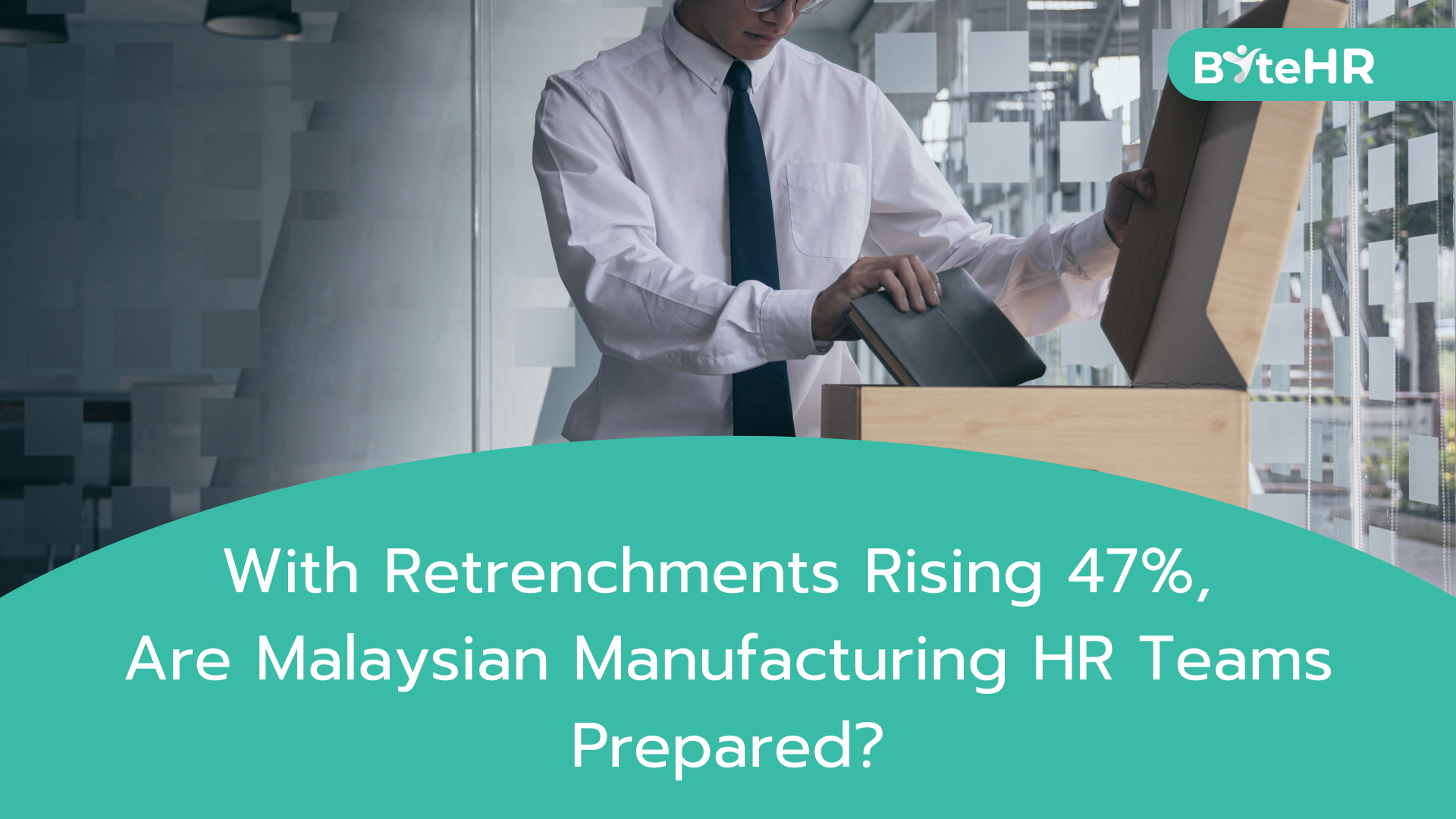
Picture an HR executive at a Selangor electronics factory settling in on a Monday morning, only to find three things waiting for her before she's even had her coffee.
A WhatsApp message from the plant manager confirming that 60 workers will be let go by the end of the month. An email from the legal team asking for employment records going back two years. And a spreadsheet she built herself, three years ago, that was never meant to handle anything remotely like this.
This isn't a hypothetical. Right now, across Malaysia's manufacturing belt, scenes exactly like this are playing out in real time, and the numbers are hard to ignore. In just the first quarter of 2026, 24,100 workers were retrenched. That's a 47% increase compared to the same period last year. Manufacturing has taken the hardest hit of any sector, battered by global trade uncertainty and softening external demand, with analysts pointing to it as the current weakest link in Malaysia's labour market.
When retrenchment volumes climb this sharply, HR teams aren't just dealing with more paperwork. They're dealing with more paperwork that has to be legally watertight, fully documented, and ready to hold up under scrutiny at any moment.
For factories still running their HR operations on spreadsheets, that's precisely where things begin to unravel.
Why Retrenchment Is an HR Crisis, Not Just a Headcount Decision
There is a tendency to think of retrenchment as a management decision that HR simply executes. In reality, the execution itself carries significant legal and operational weight that falls entirely on the HR function.
Under Malaysia's Employment Act 1955 and its subsequent amendments, employers are required to meet specific obligations when terminating employees. Termination notices must be served according to contract terms or statutory minimums. Severance pay must be calculated correctly based on each individual employee's length of service. Outstanding wages, unused annual leave, and other entitlements must all be settled before or at the point of separation. SOCSO notifications must be filed for retrenched workers to ensure they can access Employment Insurance System (EIS) benefits they are entitled to.
Every one of these steps requires accurate data. Length of service, wage history, leave balances, contract type, and contribution records all feed into the calculations. If any of that data is incomplete, inconsistent, or stored across multiple files, the risk of errors increases significantly. And in retrenchment situations, errors carry consequences beyond a simple correction in the next payroll cycle.

What Malaysian Manufacturing HR Actually Looks Like Under Pressure
Manufacturing HR in Malaysia is already complex before any retrenchment event occurs. A typical mid-sized factory in Selangor or Penang may be running two or three shifts with a workforce that includes permanent staff, contract workers on fixed-term agreements, daily-rated workers, and foreign employees under work permit conditions. Each of these categories has different statutory contribution requirements, different overtime entitlements, and in some cases, different notice period obligations.
The 2022 Employment Act amendments introduced further changes that factories needed to absorb: reduced maximum weekly working hours, extended paternity leave, and new protections around flexible work arrangements. More recently, the Gig Workers Act took effect in 2026, introducing new social protection filing requirements for non-permanent workers. Each legislative change requires HR to update policies, reconfigure calculations, and ensure that records reflect the new obligations correctly.
Factories managing all of this on Excel are effectively maintaining a system that requires manual updates every time the law changes, and manual reconciliation every time a worker's status or rate changes. Under normal operating conditions, that is already a significant burden. When a retrenchment event is added on top, the system is being asked to do something it was never built for.
The Hidden Costs of Getting Retrenchment Wrong
Most HR teams are aware of the obvious risks: incorrect severance pay, missed notice periods, incomplete SOCSO filings. But the costs of getting retrenchment wrong extend further than the immediate correction.
Statutory penalties and legal exposure. Malaysian labour law is specific about employer obligations during termination. Failure to pay severance correctly or on time can result in claims filed with the Labour Department, adjudication proceedings, and financial penalties. In a retrenchment affecting dozens of workers simultaneously, even a systematic formula error that affects a percentage of calculations can translate into multiple concurrent claims.
Document retrieval failure during disputes. When a retrenched worker disputes their entitlements, HR needs to produce documentation quickly: attendance records, payroll history, leave records, employment contracts. If that documentation is scattered across multiple Excel files, email threads, and physical folders, the ability to respond promptly is compromised. A failure to produce records in a timely way does not help the employer's position in a dispute.
Reputational and operational spillover. Retrenchment is visible inside a factory. Workers who remain are watching how their colleagues are treated. If retrenched employees experience delays, errors, or difficulty getting answers about their entitlements, that affects morale and trust among the workforce that stays. The HR function's credibility in the eyes of remaining employees is directly shaped by how it handles the exit of departing ones.
HR capacity collapsed at the worst possible time. During a retrenchment, HR teams are simultaneously managing the exit process for departing workers and continuing to support the ongoing needs of those who remain. Payroll still runs. Leave requests still come in. Compliance deadlines do not pause. A team already at capacity on manual systems has very little room to absorb the additional workload without something slipping.
How a Proper HR System Changes in This Situation
The difference between managing a retrenchment on spreadsheets and managing it on a purpose-built HR system is not just efficiency. It is accuracy, traceability, and the ability to produce the right information at the right moment without scrambling.
When employee records are centralised, HR can pull an individual worker's full employment history instantly: start date, contract type, wage progression, leave balance, contribution records. Severance calculations can be generated based on accurate data rather than manually assembled figures. SOCSO notification requirements can be tracked against actual timelines rather than relied upon from memory.
For factories with mixed workforce categories, the system handles the complexity of different rules applying to different worker types without requiring HR to maintain separate tracking mechanisms for each. When legislation changes, the system configuration is updated once, and the correct rules apply going forward across all relevant workers.
The documentation that auditors, labour inspectors, or legal proceedings might require is stored in one place, searchable, and retrievable in minutes rather than hours. That capability matters on an ordinary Tuesday. During a retrenchment, it matters considerably more.

The Factories That Will Handle This Best Are Already Prepared
The current retrenchment wave is not the last period of workforce disruption that Malaysian manufacturers will face. Global trade conditions remain uncertain. Export-driven sectors continue to face external pressure. The structural shift toward contract and non-permanent employment is ongoing, adding complexity to workforce management regardless of economic conditions.
Factories that invest in proper HR systems now are not just solving today's problem. They are building the operational foundation that allows them to manage whatever comes next without the risk of their HR function becoming the point of failure.
The HR teams managing this well are not doing more work. They are working with systems that were built for the environment they actually operate in.
ByteHR is HR software built specifically for industrial manufacturing environments, supporting multi-shift scheduling, automated OT calculations, and centralised document management in one place. Try it free today and see how much lighter your HR team's load can be. Or if you are ready to explore whether ByteHR is the right fit for your operation, reach out to the team directly at sales@byte-hr.com for a free consultation.